
The Palazzo Ducale Museum: A Definitive Guide to Italy’s Gothic Masterpiece (2026)
Plan your perfect visit to the Palazzo Ducale Museum with our 2026 guide. Get expert tips on tickets, secret tours, and how to beat the Venice crowds.
Could a single building hold the secrets of a thousand year empire within its pink marble walls? While many see a beautiful facade, the palazzo ducale museum is actually a complex architectural chronicle of sovereign power and clandestine history. You might feel overwhelmed by the centuries of data or confused by the shifting ticket tiers, and you aren't alone in that feeling. It's natural to worry about missing the hidden highlights or getting lost in the crowds that draw over 1.4 million visitors annually.
We promise to transform that uncertainty into a seamless, meaningful journey through Venice’s crown jewel. This guide provides everything you need for a perfect visit in 2026, from navigating the new "Residenti" and "Senior plus Junior" ticket options to exploring the "ETRUSCHI E VENETI" special exhibition. You'll discover how to access exclusive areas like the Secret Itineraries and make the most of the extended summer evening hours. Get ready to step past the velvet ropes with the confidence of a true cultural insider.
Key Takeaways
Uncover the evolution of the Serenissima Republic’s seat of power, tracing its transformation from a defensive fortress into a supreme global landmark.
Experience the sensory majesty of the Scala d’Oro and the unique "Venetian Gothic" architecture that defines the palazzo ducale museum.
Traverse the poignant Bridge of Sighs to explore the contrasting world of the New Prisons, where the Republic’s strict judicial history remains etched in stone.
Master the logistics of your visit by securing official fast-track tickets and timing your entry to avoid midday crowds for a more intimate encounter with history.
Learn how to access restricted chambers through the Secret Itineraries Tour or witness the palace’s atmospheric beauty after dark with special night entry.
What is the Palazzo Ducale Museum? An Icon of National Heritage
The Doge's Palace is far more than a mere stop on a tourist itinerary; it's the very soul of Venice distilled into pink marble and Istrian stone. For centuries, this site functioned as the supreme seat of the Serenissima Republic, acting as the residence of the Doge, the heart of the government, and the highest court of law. Today, the palazzo ducale museum stands as a cornerstone of Italian heritage, inviting you to step into a world where political might and artistic mastery are inextricably linked. It's a multi-layered sanctuary that preserves the clandestine history of a global maritime power, offering a sensory journey through sovereign apartments, institutional chambers, and the shadow-filled prisons.
The Evolution of a Landmark
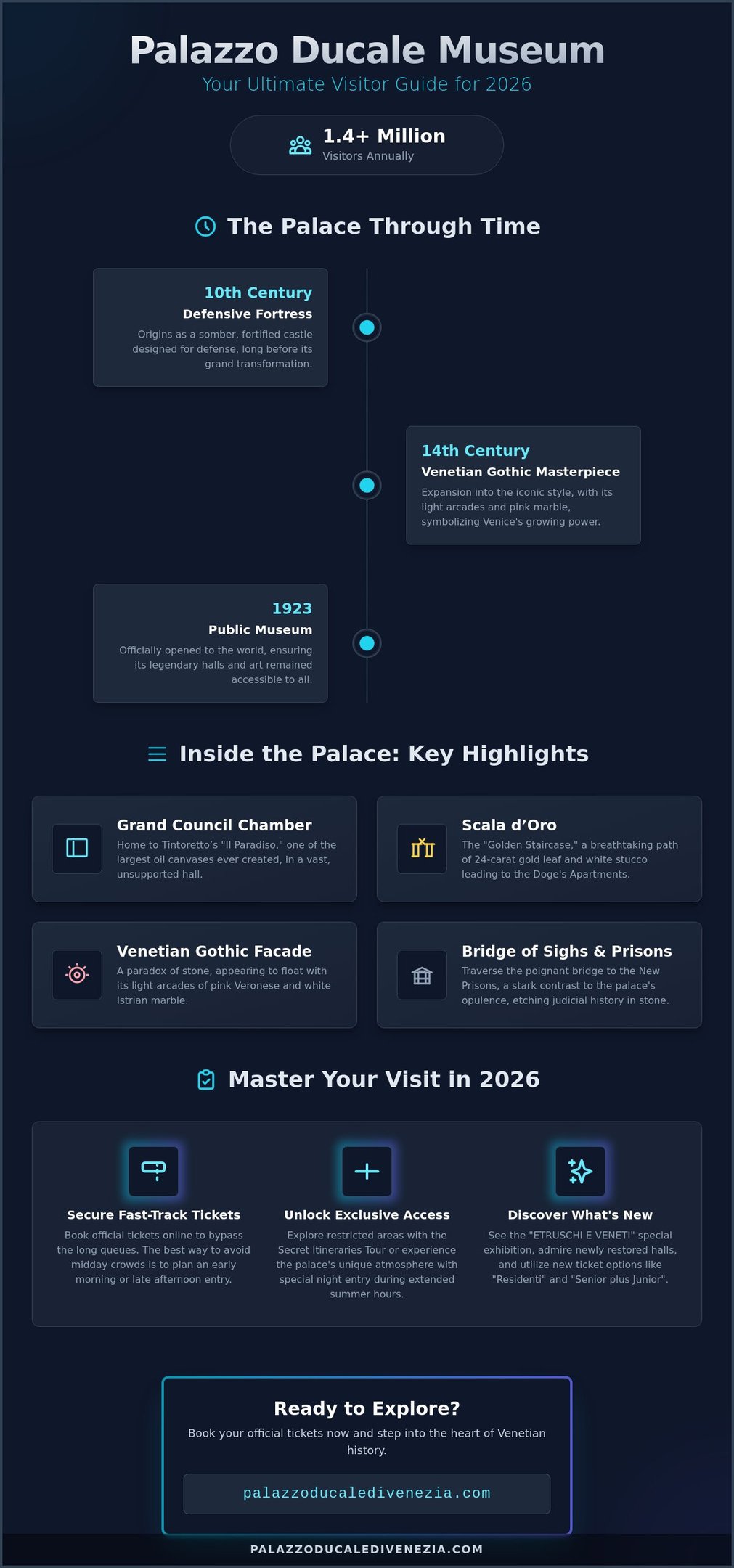
The palace you see today is the result of a profound architectural metamorphosis. Its origins trace back to the 10th century, when it stood as a somber, fortified castle designed for defense rather than display. However, as Venice’s influence expanded across the Mediterranean, the structure shifted toward the "Venetian Gothic" style we admire now. The 14th-century expansion, specifically the wing overlooking the lagoon, marked its transition into a masterpiece of European diplomacy and design. Following the fall of the Republic and decades of transition, the palace officially became a public museum in 1923. This change ensured that the legendary halls, once reserved for the elite, remained open to the world.
A Cultural Custodian of the Republic
As a cultural custodian, the museum doesn't just house art; it protects the administrative memory of an empire. Every hall, from the Doge’s private apartments to the vast institutional chambers, served a specific civic purpose. Here, the intersection of law and art is visible in every fresco and gilded ceiling. The Great Council Hall, for instance, showcases how the Republic used monumental art by masters like Tintoretto to reinforce its political ideals. By exploring the palazzo ducale museum, you gain a deep understanding of how Venice balanced the weight of justice with the pursuit of beauty. It remains a primary destination for those seeking the truth behind the Venetian legend, providing a clear window into the sophisticated governance of a vanished world.
The Architectural Splendour of the Palazzo Ducale: Art and Authority
To stand before the Palazzo Ducale is to witness a paradox of stone. Unlike the heavy, brooding fortresses of mainland Europe, this impressive structure appears to float upon its own light, airy arcades. The facade, a magnificent tapestry of white and pink Veronese marble, catches the shifting Venetian light to reflect the shimmering waters of the lagoon. It's a masterpiece of Venetian Gothic design, where delicate tracery and pointed arches create a sense of weightlessness that belies the immense power held within its walls.
Inside the palazzo ducale museum, the scale shifts from delicate grace to overwhelming authority. As of 2026, the recently completed restoration of the Sala delle Quattro Porte and the Quadreria allows you to see these spaces with a clarity not possible for decades. The vibrant colors of the frescoes and the intricate textures of the woodwork have been meticulously revived. These institutional chambers were designed to overawe visiting dignitaries, serving as a physical manifestation of the Republic's wealth and unbreakable order.
The Grand Council Chamber: Tintoretto's Paradise
The Grand Council Chamber remains one of the most awe-inspiring spaces in the world. Once the largest room in Europe, its sheer scale is difficult to grasp until you stand beneath its massive, unsupported ceiling. Dominating the far wall is Tintoretto’s "Il Paradiso," a technical marvel of 16th-century painting that remains one of the largest oil canvases ever created. The play of light from the lagoon outside illuminates the ceiling’s gilded carvings, making the entire room glow with a golden warmth. It's a space where art wasn't just decoration; it was a tool of statecraft.
The Scala d'Oro and the Doge's Private World
The transition from public duty to private authority is best experienced on the Scala d’Oro. This "Golden Staircase" served as the ceremonial path for guests of the state ascending toward the Doge's apartments. Alessandro Vittoria’s work here is breathtaking, combining 24-carat gold leaf with delicate white stucco to create a canopy of absolute luxury. Each step upward was a symbolic journey toward the heart of power. To experience this majesty without the stress of long queues, we recommend securing official Doge’s Palace tickets in advance. This allows you to focus entirely on the sensory details of the stucco and gold that define this transition to the seat of authority.
Beyond the Golden Facade: The Secrets of the Ducal Prisons
While the upper floors gleam with gold leaf and the masterful strokes of Tintoretto, the lower reaches of the palazzo ducale museum reveal a more somber side of Venetian power. The Republic’s reputation for efficiency extended far beyond trade and into a realm of strict, often ruthless, justice. To walk through these corridors is to understand that the palace wasn't just a residence for the elite; it was a complex machine of governance where the courtroom and the cell were separated by only a few feet of Istrian stone. This duality is central to the Doge's Palace History, showing a state that valued order as much as it did beauty.
Incarceration within the palace was divided into two distinct worlds. The Piombi, or "Leads," were located directly under the roof, where the lead plates made the summer heat almost unbearable. It was from these upper cells that the legendary Giacomo Casanova made his daring escape in 1756, a story that remains a narrative highlight for many visitors. Conversely, the Pozzi, or "Wells," were damp, lightless cells located at the water level. These were reserved for those convicted of the most serious crimes, offering a stark, chilling contrast to the luxury found just a few floors above.
The Bridge of Sighs: A View from Within
Crossing the Bridge of Sighs is a transition that carries immense psychological weight. From the perspective of those Inside the Bridge of Sighs, the world outside is reduced to tiny, fragmented glimpses of the lagoon through heavy stone apertures. While the name was popularized by romantic poets like Lord Byron, the historical reality was far more pragmatic. It served as a secure, claustrophobic corridor designed to move prisoners directly from the courtroom to the New Prisons without any chance of escape or public interference.
The Secret Itineraries: Navigating the Hidden Bureaucracy
To truly grasp the palace’s hidden life, you must explore the spaces once reserved for the Republic's clandestine bureaucracy. The Secret Itineraries lead you through the hidden offices of the Chancellery and the Chamber of the Inquisitors, where the state’s internal security was managed with clinical precision. These narrow corridors and wood-paneled rooms were kept secret to protect the Serenissima from foreign spies and internal dissent. Because these areas are historically dense and physically narrow, a guided perspective is invaluable for understanding how this invisible network of power maintained the palace’s golden facade for centuries.
Master Your Visit: Practical Advice for Navigating the Museum
A visit to the palazzo ducale museum is a journey through the pinnacle of Venetian history, but the sheer volume of 1.4 million annual visitors requires a strategic approach. To truly appreciate the intricate details of the Scala d’Oro or the vastness of the Grand Council Chamber, you should plan around the natural rhythms of the city. Midday often brings a surge of congestion; therefore, we recommend arriving precisely when the gates open at 9:00 AM or waiting until the softer light of the late afternoon. This timing doesn't just offer shorter queues, it provides the best photographic conditions as the sun dips lower over the lagoon, casting long, dramatic shadows across the Istrian stone arcades.
Timing and Seasonal Considerations
If you're visiting between May 1 and September 26, 2026, you can take advantage of the extended summer hours. On Fridays and Saturdays, the museum remains open until 11:00 PM, with the last admission at 10:00 PM. Experiencing the Doge’s Palace at night is an entirely different sensory experience, where the absence of midday crowds allows the palace's clandestine atmosphere to truly resonate. Before you arrive, keep this quick checklist in mind:
Footwear: Wear comfortable shoes; you'll be traversing vast halls and narrow stone stairways.
Baggage: Avoid large backpacks or bulky items. While a cloakroom is available, traveling light ensures a faster security screening.
Hydration and Rest: The museum provides a Café and a Museum Shop, perfect for a mid-tour break or finding a refined souvenir of your journey.
Enhancing the Educational Experience
The complexity of the art within the palazzo ducale museum can be overwhelming without context. Utilizing the new MUVE APP Audioguide on your mobile device provides a thematic layer to your tour, helping you identify specific allegories in the ceiling frescoes. While the audio guide offers excellent flexibility, many find that the depth of the "Secret Itineraries" requires a more personalized touch. You might wonder, is a Doge’s Palace tour worth it? For those seeking to unlock the hidden bureaucracy of the Chancellery, a professional guide is often the key to transforming a visual tour into a profound historical education.
Modern hospitality is a priority here, ensuring that this world-class landmark is accessible to everyone. The museum is equipped with elevators for those with mobility concerns, and families will find that the "baby pit-stop" and specialized restrooms provide a welcoming environment for younger travelers. To ensure your spot during these prime visiting hours, we suggest you book your Palazzo Ducale tickets well in advance to avoid disappointment at the gate.
Official Access: Securing Your Palazzo Ducale Museum Tickets
To truly honor the legacy of Venice, your journey begins with a choice: how you step into this Gothic masterpiece. Securing your entry through the official portal is the only way to ensure direct, uncompromised access to the palazzo ducale museum. In a city where time is as precious as the art itself, navigating the various ticket tiers allows you to tailor your visit to your specific interests and schedule. Whether you prefer a solitary morning walk through the Great Council Chamber or a guided exploration of hidden chambers, your access is the key to unlocking centuries of sovereign history.
In 2026, the "Skip the Line" benefit of online booking is more vital than ever. By preparing in advance, you bypass the external queues that often stretch across the Piazzetta, moving directly into the heart of the Republic's power. You can choose between several entry styles, including the standard Palazzo Ducale Tickets, the high-priority fast track ticket, or the specialized Secret Itineraries Tour. Each path offers a unique perspective on the palace's dual nature as both a residence of luxury and a site of strict administrative justice.
Choosing the Right Experience
Selecting the right experience depends on the depth of history you wish to uncover. While a standard museum entry provides a magnificent overview of the institutional chambers and the armory, the Secret Itineraries Tour is essential for those who want to see the hidden offices and the Piombi prisons mentioned earlier. For a touch of exclusivity, the Doge's Palace at Night offers an atmospheric perspective that is simply unavailable during the daylight hours. Book your Palazzo Ducale tickets here to ensure your place in these limited-capacity tours.
Booking with Confidence
Choosing the official portal isn't just a matter of convenience; it's about professional reliability and peace of mind. You'll receive instant confirmation and digital tickets that reside safely on your mobile device, eliminating the need for physical paperwork or stressful last-minute searches. It's a seamless process that reflects the modern hospitality of this world-class landmark. Don't forget to check your pass for additional benefits, as it often includes access to the Museo Correr and temporary 2026 exhibitions like the "ETRUSCHI E VENETI" display.
The Palazzo Ducale is a living chronicle of power, justice, and artistic mastery. By selecting the right access and planning with precision, you don't just visit a museum; you become a guest of the Serenissima. Step across the threshold today and experience the palace’s timeless elegance firsthand.
Step Into the Heart of Venetian Legacy
The palazzo ducale museum is not merely a collection of galleries; it's a living architectural chronicle that invites you to witness the very intersection of supreme power and clandestine justice. You've discovered how the golden glow of the Scala d'Oro contrasts with the somber shadows of the Piombi prisons, and how the 2026 restorations have breathed new life into the Sala delle Quattro Porte. This landmark remains a testament to the Republic's enduring spirit, offering a sensory experience that bridges the gap between the medieval fortress and the modern cultural sanctuary.
To ensure your journey is as seamless as the Doge’s own ceremonial processions, we invite you to secure your official Palazzo Ducale tickets online today. By choosing our official authorized portal, you gain access to fast-track entry options that bypass the crowds and exclusive Secret Itineraries access for a truly comprehensive tour. Your encounter with the timeless elegance of Venice is waiting. Step through the Porta della Carta and begin your own chapter in this thousand year story.
Frequently Asked Questions
What is included in a standard Palazzo Ducale museum ticket?
A standard ticket offers a comprehensive cultural journey that extends beyond the palace itself. It grants you access to the Doge's Palace, the Museo Correr, the National Archaeological Museum, and the monumental rooms of the Marciana Library. This combined pass allows you to explore the full breadth of St. Mark’s Square’s history over several days, ensuring you don't miss the diverse artistic and archaeological treasures of the Republic.
How much time should I allocate for a full visit to the Doge’s Palace?
You should plan to spend at least 90 minutes to two hours for a standard self-guided tour of the galleries and prisons. If you've reserved a spot on the Secret Itineraries tour or wish to linger in the Grand Council Chamber, we recommend allocating three hours. This ensures you can appreciate the intricate ceiling frescoes and historical context without feeling rushed through the majestic halls.
Can I see the Bridge of Sighs from inside the museum?
Yes, you'll physically cross the Bridge of Sighs as you move from the courtroom to the New Prisons. From the interior of the bridge, you can peer through the decorative stone apertures to see the lagoon and the San Giorgio Maggiore island. It's a poignant moment that offers a unique perspective on the city from the eyes of those once held within the palazzo ducale museum.
Are there specific dress codes or bag restrictions for the palace?
While there isn't a strict religious dress code, we suggest wearing respectful attire that reflects the dignity of this national landmark. Large backpacks, bulky bags, or long umbrellas aren't permitted inside the galleries to protect the delicate artwork. A cloakroom is available at the entrance to store your belongings, allowing you to navigate the narrow corridors and steep staircases with ease and safety.
Is the Secret Itineraries tour suitable for children?
The Secret Itineraries tour is generally suitable for children aged six and older who are comfortable with confined spaces and steep stairs. The narrative of Casanova’s daring escape and the hidden prison cells often captivates younger imaginations. Parents should be aware that the tour involves significant walking and doesn't accommodate strollers; however, the museum provides a "baby pit-stop" in the main areas for families.
What are the opening hours for the Palazzo Ducale museum in 2026?
During the 2026 summer season, the palazzo ducale museum is open daily from 9:00 AM to 7:00 PM, with the final entry at 6:00 PM. In the winter months, the doors close slightly earlier at 6:00 PM. For those seeking a unique evening experience, the palace offers extended hours until 11:00 PM on Fridays and Saturdays between May 1 and September 26, 2026.
Is it necessary to book tickets for the Palazzo Ducale in advance?
Booking your tickets in advance is highly recommended to ensure you don't spend your visit waiting in long queues. With over 1.4 million annual visitors, the demand for entry is significant, especially during the peak summer months. Reserving your spot online allows you to select a specific entry time and guarantees your access to specialized tours that often sell out weeks in advance.
© PalazzoDucaleDiVenezia.com
Disclaimer: PalazzoDucaleDiVenezia.com is a participant in affiliate advertising programs. We provide links to authorized platforms and merchant sites, which means we may earn a commission on qualifying purchases made through our links. This comes at no extra cost to our readers and helps support the maintenance of this site.
