
Doge's Palace Art Masterpieces: A Guide to the Republic's Visual Legacy
Unlock the political secrets of the Doge's Palace art masterpieces. Our guide decodes the hidden symbolism in works by Tintoretto, Veronese, and Tiepolo.
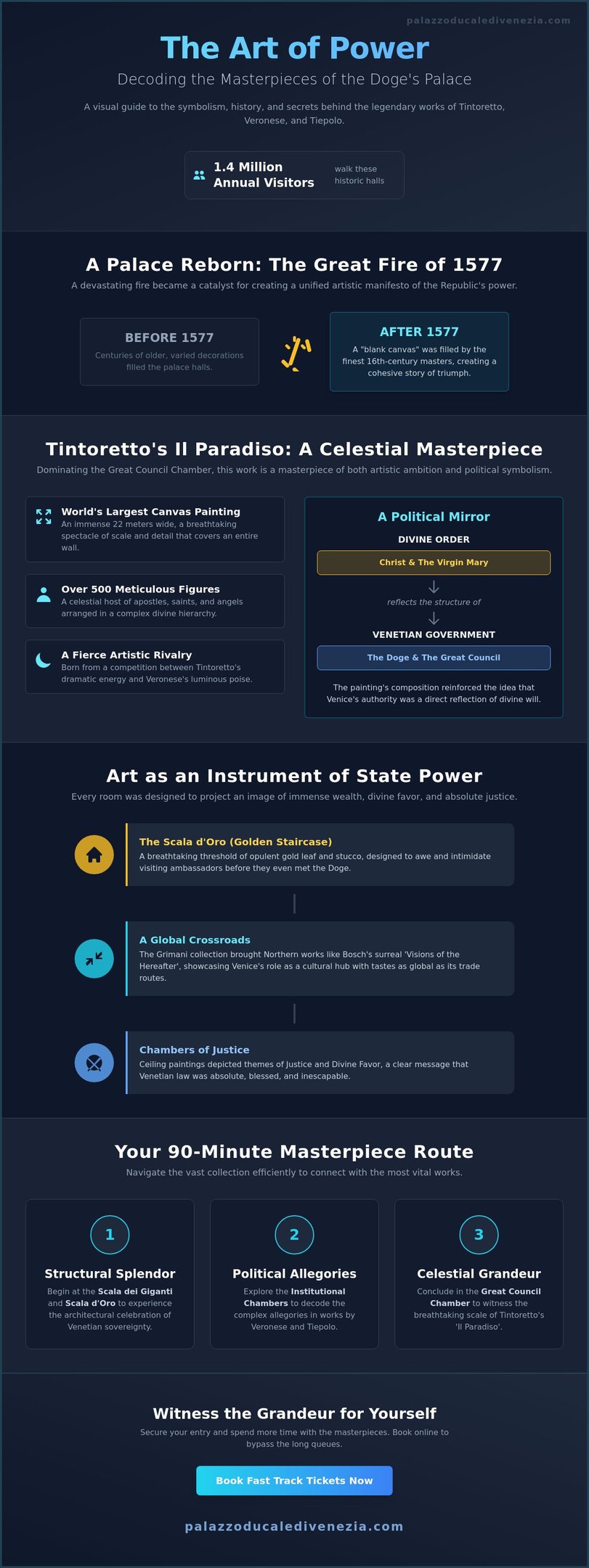
Could a single room hold the weight of a thousand years of sovereign pride? Every gilded ceiling and sprawling canvas within the Doge's Palace Venice was once a calculated instrument of state propaganda, designed to immortalize the Republic's eternal power. It's easy to feel lost among the endless corridors, yet the true brilliance of the Doge's Palace art masterpieces lies in the hidden language of their symbolism. While roughly 1.4 million annual visitors walk these halls, many overlook the subtle political messages woven into the legendary works of Tintoretto, Veronese, and Tiepolo.
You likely recognize the sheer opulence of the Great Council Chamber, but you might feel overwhelmed trying to decode the allegorical secrets hidden in plain sight. We understand that facing such a vast collection can be daunting without a clear narrative thread to follow. This guide promises to reveal the stories and secrets behind the palace's most significant works, transforming your visit into a deep exploration of history and artistry. We'll provide a curated route to see the best masterpieces efficiently, ensuring you connect with the visual legacy of the Republic without missing a single vital detail.
Key Takeaways
Understand how the Great Fire of 1577 redefined the palace's interior, transforming it into a unified visual manifesto of the Republic's immense wealth and resilience.
Uncover the technical mastery behind Tintoretto's Il Paradiso, the world's largest canvas painting, which dominates the Great Council Chamber with its celestial scale.
Decode the complex political allegories found within Doge's Palace art masterpieces by Veronese and Tiepolo to see how art functioned as an instrument of state power.
Discover the symbolic significance of the Scala dei Giganti and the Scala d'Oro, where sculpture and architecture meet to celebrate Venetian sovereignty over land and sea.
Learn how to navigate the palace's vast collection efficiently using a curated 90-minute route and an audio guide to unlock deeper layers of historical meaning.
The Artistic Manifesto of a Maritime Empire
The Doge's Palace stands as a 'Gesamtkunstwerk,' a total work of art where architecture, sculpture, and painting converge to broadcast the Serenissima’s immense wealth. It isn't merely a collection of rooms; it's a meticulously crafted manifesto of a maritime empire. The Great Fire of 1577 served as a pivotal, if devastating, catalyst for this visual unity. By sweeping away centuries of older decorations, the fire granted the Republic a blank canvas. The 'Procurators,' high-ranking officials responsible for the palace's upkeep, seized this moment to commission the world's finest painters. This rare historical opportunity created one of the most cohesive displays of 16th-century mastery found anywhere in Europe, ensuring that the Doge's Palace art masterpieces tell a singular story of triumph and divine mandate.
The Picture Gallery and Flemish Influences
You might expect only Venetian masters within these walls, but the palace holds a startling northern secret. The Grimani collection brought the enigmatic works of Jheronimus Bosch into the very center of Venetian power. His triptychs, filled with surreal and haunting imagery, offer a sharp contrast to the luminous local style. In the Chamber of the Quarantia Criminale, these Flemish influences reveal the Republic’s role as a cultural crossroads. Look for the 'Visions of the Hereafter' to see how northern perspectives were integrated into the palace’s narrative, proving that Venice’s artistic appetite was as global as its trade routes. These works provide a rare glimpse into the private tastes of the Venetian elite beyond the official state commissions.
Art as an Instrument of State Diplomacy
Every gilded frame and frescoed ceiling functioned as a tool of intimidation and awe. When foreign dignitaries entered, they weren't just seeing art; they were experiencing the psychological weight of the State. The Scala d'Oro, or Golden Staircase, served as a breathtaking threshold. Its opulent stucco work and gold leaf were designed to make visiting ambassadors feel small before the Republic’s grandeur. This calculated brilliance continues in the institutional chambers, where every ceiling panel depicts themes of justice and divine favor. These works reminded guests that Venetian law was both absolute and blessed, turning a simple walk through the palace into a lesson in political submission. Understanding these Doge's Palace art masterpieces requires looking past the beauty to see the power they were built to project.
Tintoretto’s Il Paradiso: The Pinnacle of Venetian Mastery
Step into the Chamber of the Great Council and you're immediately confronted by a celestial spectacle that defies human scale. Dominating the entire eastern wall, Tintoretto's Paradise is a masterpiece of such ambition that it remains the world's largest oil painting on canvas. This 22-meter-wide vision was born from a fierce artistic rivalry. Following the 1577 fire, the Republic sought a replacement for the destroyed Guariento fresco. The competition between Jacopo Tintoretto and Paolo Veronese was legendary, representing a battle between Tintoretto's dramatic energy and Veronese's luminous poise. While Veronese initially shared the commission, his passing in 1588 allowed Tintoretto to take the lead, immortalizing his legacy among the Doge's Palace art masterpieces.
The painting isn't just a religious scene; it's a political mirror. The concentric circles of the heavenly host reflect the very structure of the Venetian government that deliberated beneath it. Just as the Doge sat at the center of the Republic's power, Christ and the Virgin Mary sit at the apex of this divine hierarchy. It's a breathtaking demonstration of how Venice viewed its own authority as a reflection of the divine order. If you want to witness this grandeur without the fatigue of long queues, consider securing a fast track ticket to ensure you have ample time to study the details.
Symbolism in the Hall of the Great Council
At the painting's heart, the figures of Christ and the Virgin Mary radiate a golden light that illuminates the entire chamber. Surrounding them are over 500 meticulously rendered figures, including apostles, saints, and angels, all arranged in a complex 'Paradise' of the state. This vast assembly integrates seamlessly with the frieze of portraits depicting the first 76 Doges of Venice. Notice the black veil covering the portrait of Marino Faliero, the Doge executed for treason. This juxtaposition of heavenly glory and earthly justice reminds every councillor of their solemn duty to the Republic.
The Artistic Technique of Jacopo Tintoretto
Tintoretto's success relied on 'Prestezza,' a technique of rapid, energetic brushwork that allowed him to cover immense surfaces with startling speed. He didn't seek the polished finish of his contemporaries. Instead, he used dramatic chiaroscuro to create a sense of deep, swirling space that pulls the viewer into the divine realm. The flickering light and shadow give the hundreds of figures a sense of constant motion. Completed in 1588, this monumental canvas effectively transformed the architectural limits of the room into an infinite celestial horizon.
Allegories of Sovereignty: Masterpieces by Veronese and Tiepolo
While Tintoretto captured the raw, spiritual energy of Venice, Paolo Veronese and Giambattista Tiepolo brought a luminous clarity to the Doge's Palace art masterpieces. Veronese, the master of light and color, transformed the Hall of the Scrutiny with his 'Triumph of Venice.' His palette, characterized by brilliant silvers, sky blues, and rich crimsons, distinguishes him from the darker, more turbulent tones of his contemporaries. These works aren't merely decorative; they use allegorical figures like Justice, Peace, and Victory to personify the state’s virtues. By giving human form to abstract concepts of governance, these artists made the Republic’s moral authority visible to every visiting dignitary.
The Ceiling of the Hall of the Council of Ten
In the Hall of the Council of Ten, Veronese’s 'Jupiter Hurling Thunderbolts at the Vices' delivers a stern political message. It depicts a divine authority purging corruption, a clear warning to those who might betray the Republic's strict laws. The painting is framed by intricate, gold-leafed wood carvings that create a three-dimensional depth, typical of the palace's opulent style. To truly appreciate these works, look directly upward from the center of the room. The artists used a perspective technique known as 'di sotto in sù' (from below upwards) to ensure figures appear anatomically correct from your vantage point on the floor. This mastery of space is also evident in Tintoretto's ceiling paintings in the Atrio Quadrato, which set the standard for the palace's overhead narratives.
Tiepolo and the Twilight of the Empire
As the Republic entered its final century, Giambattista Tiepolo was called upon to reinforce its fading status. His 'Neptune and Venice' (often called 'The Gifts of the Sea') in the Four Doors Room marks a definitive shift from Renaissance weight to Rococo lightness. Here, Neptune pours out the treasures of the ocean at the feet of a regal Venice. It's a late masterpiece of the Republic that sought to reclaim its maritime glory through visual splendor. Tiepolo’s airy compositions and pastel tones suggest a sense of ethereal elegance, proving that even in its twilight, Venice remained a beacon of artistic mastery. These Doge's Palace art masterpieces serve as a poignant reminder of an empire that used beauty to sustain its legend until the very end.
Structural Splendor: The Staircases and Statuary
The very skeleton of the Palazzo Ducale serves as a gallery, where the transition from Gothic intricacy to Renaissance order is carved directly into the stone. On the exterior corners, the 'Judgment of Solomon' stands as a profound example of 15th-century high-relief sculpture, emphasizing the Republic's obsession with divine justice. These architectural elements are as vital to the collection as any canvas, acting as Doge's Palace art masterpieces that define the building's physical presence. The structure doesn't just house art; it is art, with every arcade and capital telling a story of civic pride and artistic evolution. To experience these details in their full context, many visitors find that Doge's Palace Tickets with an audio guide help illuminate the architectural nuances that the naked eye might overlook.
The Giants’ Staircase and Sansovino’s Influence
In the heart of the courtyard, the Scala dei Giganti commands attention as the ceremonial stage for the Doge’s coronation. Jacopo Sansovino’s colossal statues of Mars and Neptune stand at the summit, personifying Venice’s absolute power over both land and sea. These figures are not merely decorative; they are political statements in Carrara marble. The steps themselves are adorned with geometric marble inlays of porphyry and serpentine, creating a rhythmic pattern that leads the eye toward the triumphal arch above. This staircase transformed the act of entering the palace into a theatrical display of state authority, ensuring every new leader understood the weight of their office.
Interior Statuary and the Museo dell’Opera
Beyond the grand staircases, the palace’s sculptural legacy continues in the Museo dell’Opera. This space houses the original 14th-century capitals, which were removed from the exterior facades to protect them from erosion. These narrative carvings feature a staggering variety of subjects, from biblical parables to the labors of the months, providing a window into the medieval Venetian mind. Nearby, the 'Adam and Eve' statues by Antonio Rizzo showcase the early Renaissance shift toward anatomical realism and classical poise. These Doge's Palace art masterpieces represent a crucial turning point, where the heavy symbolism of the Middle Ages began to give way to the human-centered beauty of the Renaissance. Exploring these works allows you to witness the building’s transition from a defensive stronghold to a sophisticated center of European culture.
Curating Your Masterpiece Route: Practical Insights for 2026
To truly appreciate the Doge's Palace art masterpieces, one must approach the building with the precision of a curator. With approximately 1.4 million visitors arriving annually, the sheer scale of the palace can feel overwhelming without a structured plan. A focused 90-minute 'Art Lover’s Checklist' ensures you witness the most vital works without suffering from museum fatigue. Begin your journey at the Scala d'Oro to experience the transition from architecture to interior opulence. From there, prioritize the Hall of the Four Doors to see Tiepolo’s Neptune, before moving through the institutional chambers to the Hall of the Council of Ten for Veronese’s ceiling works. Conclude your route in the Great Council Chamber, where Tintoretto’s 'Il Paradiso' demands a quiet moment of reflection. To understand the complex political allegories and identify the 'who’s who' among the hundreds of portraits, visiting with Audio Guide is essential for a deep, scholarly connection to the collection.
Maximizing Your Artistic Experience
Timing is everything when it comes to visual clarity. For the best natural light, aim to visit in the early morning or late afternoon when the sun’s rays illuminate the golden ceilings and clarify the textures of the massive canvases. Using a fast track ticket is a strategic choice that preserves your mental energy for the art rather than the queue. Remember to look up constantly. The Venetian Republic intentionally placed its most profound messages on the ceilings, turning every room into a three-dimensional narrative. To see the 'other side' of the palace’s story, combine your art walk with a Secret Itineraries Tour, which provides the gritty, historical context that makes the beauty of the public rooms even more striking.
Securing Your Access to the Palace in 2026
Booking strategies in 2026 favor the prepared traveler. Under current dynamic pricing, a full ticket costs €30.00 if purchased more than 30 days in advance, rising to €35.00 for last-minute bookings. Planning ahead doesn't just save money; it guarantees your preferred entry time during peak months. For a truly unique perspective, consider visiting on a Friday or Saturday between May and September 2026. During these months, the palace extends its hours until 23:00. Experiencing the Doge's Palace at Night offers a rare, atmospheric view of the masterpieces under moonlight and specialized interior lighting, free from the daytime crowds. Book your official tickets here to experience these masterpieces firsthand and ensure your place within the halls of the Republic's visual legacy.
Step Into the Living Legacy of Venice
The Doge's Palace is more than a museum; it's a profound testament to a thousand years of Venetian sovereignty. By exploring the Doge's Palace art masterpieces, you aren't just viewing paintings; you're decoding the very soul of the Republic. From the celestial heights of Tintoretto's 'Il Paradiso' to the gilded precision of the Golden Staircase, every detail serves a specific political and artistic purpose. You've learned how these works functioned as diplomatic tools and how to navigate the collection with the efficiency of a seasoned scholar.
Now, it's time to witness this grandeur for yourself. Through our Official Ticketing Portal, you can access Fast-Track Entry Options to bypass the queues or secure Exclusive Secret Itineraries Access for a deeper look into the palace's hidden history. Secure your official Doge's Palace tickets and explore these artistic treasures today. We look forward to welcoming you into the heart of Venice’s visual legacy, where every corridor promises a new revelation. The timeless beauty of the Serenissima is waiting for you.
Frequently Asked Questions
Who are the most famous artists with works in the Doge's Palace?
Tintoretto, Paolo Veronese, and Giambattista Tiepolo are the most prominent masters whose works define the palace's interior. You'll also encounter significant contributions from Titian, Vittore Carpaccio, and the sculptor Jacopo Sansovino. These artists were carefully selected by the Republic's officials to create a unified visual narrative of Venetian power and divine favor across the centuries.
What is the most famous painting in the Doge's Palace?
Tintoretto's "Il Paradiso" is undoubtedly the most celebrated work within the palace walls. Dominating the Great Council Chamber, it holds the title of the world's largest oil painting on canvas. Its complex composition and massive scale make it an essential highlight for anyone seeking to understand the grandeur of Doge's Palace art masterpieces and their role in state propaganda.
Can I see works by Titian inside the Palace?
Yes, you can find Titian’s hand in several locations, most notably the "Saint Christopher" fresco located in the Doge's Apartments. While many of his earlier works were lost in the devastating fire of 1577, this surviving piece offers a rare look at his fresco technique. It showcases his characteristic use of bold color and monumental human forms in a uniquely intimate setting.
Is the Bridge of Sighs considered an artistic masterpiece?
The Bridge of Sighs is a masterpiece of Baroque architectural sculpture, designed by Antonio Contino in 1600. Its delicate Istrian limestone carvings and elegant enclosed archway represent a peak of Venetian engineering and aesthetic design. While it served a functional purpose as a corridor to the New Prisons, its beauty has made it one of the most iconic structural features of the palace complex.
How much time do I need to see the main art masterpieces?
You should reserve at least 90 minutes to two hours to explore the primary artistic highlights of the interior. This allows sufficient time to traverse the institutional chambers and spend a few quiet moments in the Great Council Chamber. If you intend to use an audio guide or visit the temporary exhibitions in the Doge's Apartments, three hours is a more comfortable duration for a thorough experience.
Are there any works by Bosch in the Doge's Palace?
The palace houses a remarkable collection of northern art, including several triptychs by the Dutch master Jheronimus Bosch. These surreal works, such as the "Visions of the Hereafter," came from the prestigious Grimani collection. They offer a startling and fantastic contrast to the classical Venetian style, proving the Republic’s diverse cultural reach and the sophisticated tastes of its ruling elite.
Why are there so many paintings of lions in the Palace?
The winged lion is the primary symbol of Saint Mark, the patron saint of Venice, and serves as the ultimate emblem of the Republic's authority. You'll find it depicted in countless Doge's Palace art masterpieces, from Carpaccio's famous canvas to the monumental sculptures guarding the entrances. It was a visual shorthand for Venetian strength, justice, and the state’s perceived divine protection on both land and sea.
Is photography allowed of the paintings inside the rooms?
Photography for personal, non-commercial use is permitted throughout the palace, provided you don't use a flash, tripods, or selfie sticks. This policy allows you to document the breathtaking details of the gilded ceilings and massive canvases. We recommend being mindful of other visitors in the smaller chambers, especially during peak hours, to ensure everyone can enjoy the masterpieces without obstruction.
© PalazzoDucaleDiVenezia.com
Disclaimer: PalazzoDucaleDiVenezia.com is a participant in affiliate advertising programs. We provide links to authorized platforms and merchant sites, which means we may earn a commission on qualifying purchases made through our links. This comes at no extra cost to our readers and helps support the maintenance of this site.
