
Doge's Palace Architecture: A Masterclass in Venetian Gothic and Design
Uncover the secrets of Doge's Palace architecture. This guide decodes its Venetian Gothic style, from floating marble walls to the Bridge of Sighs.
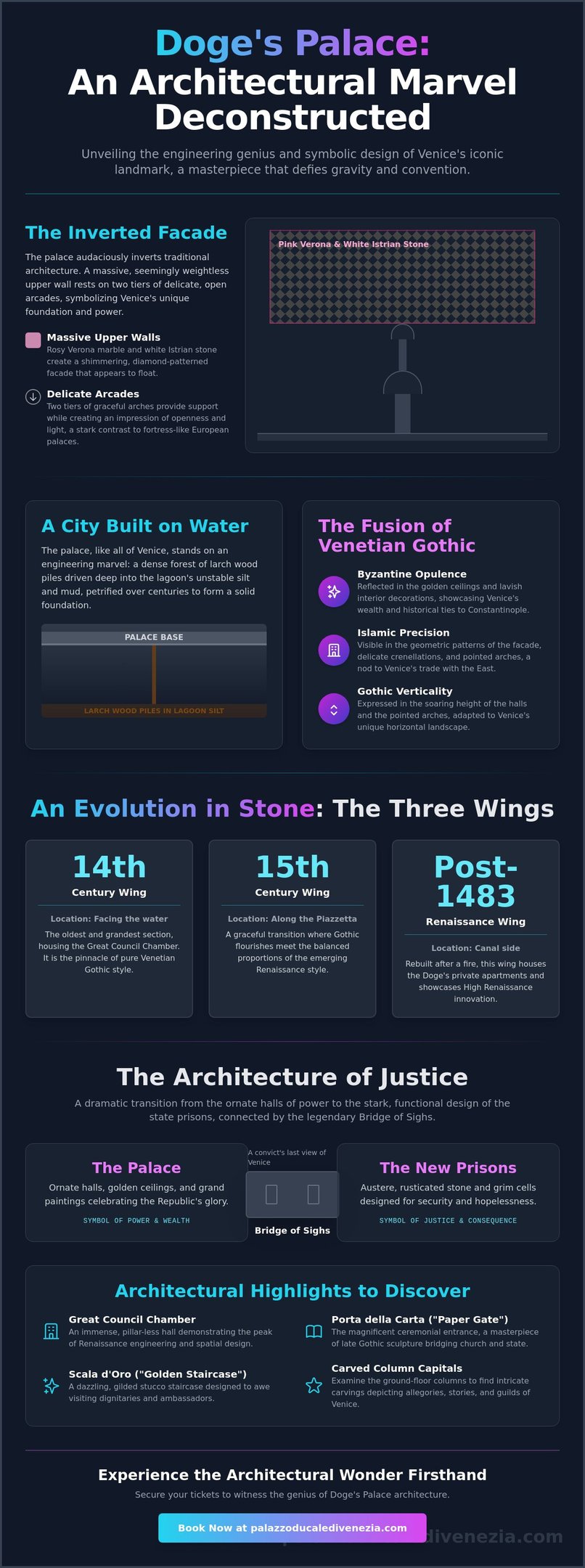
The Doge's Palace is a profound architectural paradox where massive, ornate stone structures seem to hover weightlessly over delicate open arches, mirroring the impossible rise of Venice itself. You might feel a sense of overwhelming awe when standing before its pink marble facade, perhaps worrying that the building's sheer scale will make you miss the subtle stories etched into its columns. It's natural to feel dwarfed by such a landmark, but understanding the logic behind Doge's Palace architecture transforms a simple visit into a journey through the heart of Venetian power and artistic mastery.
In this exploration, you'll discover the architectural secrets and must-see structural masterpieces hidden within the walls of this world-famous palace. We've curated a list of highlights that define the Venetian Gothic style, helping you decode the symbolic meanings behind every quatrefoil and carved capital. You'll also gain a new appreciation for the engineering marvels that keep the palace standing on its ancient forest of wooden piles. From the golden ceilings of the institutional chambers to the somber beauty of the Bridge of Sighs, you're about to see this masterpiece with the clarity it deserves.
Key Takeaways
Understand how Venetian Gothic blends Byzantine and Islamic influences to create a style that defined the Republic's golden age.
Learn to decode the "inverted" logic of Doge's Palace architecture, where massive pink marble walls appear to float elegantly atop delicate, airy arcades.
Discover the engineering secrets of the Great Council Chamber, a vast, pillar-less marvel that demonstrates the peak of Renaissance spatial design.
Explore the dramatic transition from the palace's ornate institutional halls to the austere, rusticated stone of the New Prisons across the Bridge of Sighs.
Identify the best moments to witness the play of light on the marble facade and learn how to uncover hidden architectural details that most visitors miss.
The Architectural Logic of the Doge's Palace: A Gothic Masterpiece on Stilts
To understand the Doge's Palace, one must first grasp the audacity of its design. It isn't merely a government building; it's a visual manifesto of a maritime empire that once stood at the center of the known world. The Doge's Palace architecture represents the pinnacle of Venetian Gothic, a style that refuses to be categorized by European standards alone. Instead, it's a sophisticated tapestry of Byzantine opulence, Northern European Gothic verticality, and Islamic geometric precision. This fusion created a building that looks like no other in the world, famously defined by its "inverted" facade. While most medieval structures place heavy stone at the base for stability, the Palazzo Ducale features massive, solid pink marble walls supported by two tiers of delicate, airy arcades. This defies traditional logic, yet it has stood for centuries on a foundation of ancient larch wood piles driven deep into the lagoon's silt.
The palette of the palace is equally intentional. Master builders used white Istrian stone and rosy Verona marble to create the shimmering, diamond-patterned facade that changes hue with the shifting Adriatic light. It's a triumph of engineering and aesthetics that continues to support the weight of history for the millions who visit each year. The sheer weight of the upper floors, which house the great halls of state, is distributed with mathematical precision across the columns below, proving that in Venice, beauty and structural integrity are inseparable.
Orientalism and the Venetian Style
Venice's identity was forged through trade with the East, and this "Orientalism" is etched into every stone of the palace. The delicate crenelations along the roofline and the intricate pointed arches are direct nods to Islamic architecture found in Cairo and Constantinople. Unlike the fortress-like palaces of Florence or Rome, the palace remains strikingly open and unfortified. This design was a bold political statement. The Republic's true walls were its invincible naval fleet, allowing its seat of power to be a transparent center of diplomacy rather than a closed bunker. The Islamic-inspired patterns on the upper facade further emphasize Venice's role as the bridge between East and West.
The Three Wings of the Palazzo Ducale
The evolution of Doge's Palace architecture is best observed through its three distinct wings that wrap around a central courtyard. The oldest section, dating to the 14th century, faces the water and houses the grandest institutional halls. The 15th-century wing extends along the Piazzetta, marking a graceful transition where Gothic flourishes began to meet the balanced proportions of the early Renaissance. Finally, the canal-side wing contains the Doge's private apartments. This later addition showcases the height of Renaissance innovation, offering a more intimate look at the life of Venice's leader. To truly grasp these transitions, securing Doge's Palace Tickets with an audio guide provides the necessary context to distinguish between these competing layers of history.
The Entry Sequence: Navigating the Porta della Carta and Scala d'Oro
Entering the Doge's Palace is more than just crossing a threshold; it's a choreographed ritual of statecraft. The Doge's Palace architecture ensures that every visitor, from 15th-century ambassadors to modern travelers, feels the weight of Venetian authority before they even reach the first council chamber. This journey begins at the Porta della Carta, the ceremonial gate that bridges the gap between the religious sanctity of St. Mark's Basilica and the secular power of the palace. It's a threshold designed to impress, signaling that you're leaving the public square and entering the heart of an empire.
The Symbolism of the Porta della Carta
Crafted by the renowned Giovanni and Bartolomeo Bon, this "Paper Gate" is a masterpiece of late Gothic sculpture. Its name likely stems from the public scribes who once set up shop nearby or the official archives kept within. As you look up, you'll see Doge Francesco Foscari kneeling before the winged Lion of Saint Mark. It's a potent visual cue of the Doge's humility before the patron saint of Venice, yet the gate's sheer ornamentation reminds everyone of the Republic's immense wealth. This entrance serves as the primary physical link between the palace and the Basilica, weaving the city's spiritual and political hearts together into a single, unified expression of power.
Once through the gate, you emerge into the central courtyard. This transitional space is where the pointed Gothic arches of the older wings meet the balanced, geometric symmetry of the Renaissance. At its center stands the Scala dei Giganti, the Giants' Staircase. Flanked by colossal statues of Mars and Neptune, this was the stage where the Doge was crowned. He stood between the gods of war and the sea to symbolize Venice's dual dominance over land and water. To truly appreciate these intricate carvings and the history they represent, securing Palazzo Ducale Tickets with an audio guide helps reveal the stories hidden in the stone.
Ascending the Scala d'Oro
The true climax of the entry sequence is the Scala d'Oro, or the Golden Staircase. This isn't merely a way to reach the upper floors; it's a symbol of the Republic's prestige. Designed by Jacopo Sansovino and finished by Alessandro Vittoria, its barrel vault is encrusted with 24-carat gold leaf stuccowork. In the days of the Republic, this staircase acted as a physical filter for social hierarchy. Only the nobles whose names were inscribed in the "Golden Book" were permitted to ascend these steps to the government chambers.
Allegorical Mastery: Look for the figures of Justice and Fortitude on the ceiling, reminding officials of the virtues required to lead the Venetian state.
Engineering Grace: Notice how the staircase manages to feel light and airy despite the heavy marble and gold ornamentation.
Control of Access: The Scala d'Oro served as a grand waiting room, where the decor worked to intimidate and impress foreign dignitaries before their official audiences.
What to See Inside Doge's Palace: Masterpieces of Space and Scale
Stepping inside the upper floors reveals the true ambition of the Venetian state. While the exterior dazzles with its shimmering marble, the internal Doge's Palace architecture was meticulously designed to facilitate the complex machinery of a global maritime empire. Every room served a specific administrative purpose, and the scale of these spaces was intended to leave foreign dignitaries both awed and intimidated. It's here that the transition from the "inverted" logic of the facade to the soaring, pillar-less interiors becomes most apparent, showcasing an engineering prowess that was centuries ahead of its time.
The Engineering of the Great Council Chamber
The Sala del Maggior Consiglio, or Great Council Chamber, is the crown jewel of the palace's interior. Measuring roughly 53 meters long and 25 meters wide, it remains one of the largest rooms in Europe. The most striking feature isn't just its size, but the fact that it contains no internal columns to support the roof. This was achieved through a revolutionary system of massive wooden trusses hidden in the attic, which suspend the ceiling and create a vast, unobstructed space. This design ensured that the thousand-plus members of the council could see the Doge without visual interference. Dominating the end of the hall is Tintoretto's Paradise, the largest oil painting on canvas in the world, while the frieze above displays the portraits of 76 Doges. Look closely for the black shroud covering the space where Marin Faliero's portrait should be; it's a grim architectural reminder of the Republic's stance on treason.
Renaissance Art Meets Gothic Structure
As you move into the institutional chambers, the atmosphere shifts from the monumental to the intensely focused. In rooms like the Chamber of the Council of Ten, the Doge's Palace architecture transitions from the older Gothic style into the height of Renaissance luxury. The heavy wooden ceilings of earlier centuries were replaced with elaborate, gilded carvings that frame masterpieces by Veronese. These spaces were the nerve center of Venetian intelligence and statecraft. For visitors who want to see the narrow passageways and hidden offices where the city's real work happened, comparing the standard vs. secret itineraries is essential to understanding the building's functional anatomy.
The journey concludes in the Doge's Apartments, which offer a more intimate perspective. While these rooms feature magnificent fireplaces and carved ceilings, they were historically stripped of their furniture upon a Doge's death. This served as a symbolic reminder that the palace, and the power it represented, belonged to the Republic of Venice rather than to any single individual.
The Architecture of Justice: The Bridge of Sighs and the Prisons
The transition from the gilded halls of state to the somber confines of the judiciary represents the most dramatic shift in Doge's Palace architecture. While the main chambers dazzle with gold leaf and Renaissance masterpieces, the spaces dedicated to Venetian justice speak a different, more austere language. This architectural pivot from light to shadow was a deliberate expression of the Republic's power. It served as a reminder that the same state capable of commissioned beauty was equally capable of absolute, unyielding discipline. Nowhere is this contrast more evident than in the physical crossing from the Palazzo Ducale to the New Prisons via the Bridge of Sighs.
Built around 1600 by Antonio Contin, the Bridge of Sighs is an enclosed Baroque passageway crafted from white Istrian stone. Unlike the open loggias of the palace facade, this bridge is entirely sealed, featuring only small stone lattices through which a prisoner might catch a final, fleeting glimpse of the lagoon. Internally, the bridge utilizes a clever dual corridor system. This engineering choice was purely functional, designed to ensure that prisoners moving to and from the magistrate's offices never encountered one another, maintaining the secrecy and isolation essential to the Venetian legal process.
The Design of the New Prisons
Across the canal, the Prigioni Nuove (New Prisons) present a radical departure from the Gothic grace of the main palace. Designed by Antonio da Ponte, the architect of the Rialto Bridge, this was one of the first buildings in the world specifically constructed to serve as a prison. The exterior features heavy, rusticated stone that projects a sense of impenetrable strength. Inside, the architecture prioritizes security and surprisingly advanced ventilation for the era. Moving from the warm, textured marble of the palace courtyard into these cold, damp corridors creates a profound psychological impact, making the weight of the stone feel almost tangible to those who walk its halls today. For a deeper look into these restricted areas, you can book the Secret Itineraries Tour to experience the transition firsthand.
Casanova's Escape and the 'Piombi'
The Doge's Palace architecture also conceals the 'Piombi', or 'The Leads'. These were the attic cells located directly beneath the palace's lead-covered roof. In summer, the metal plates made the heat unbearable; in winter, the cold was biting. These secret rooms were managed by the State Inquisitors and were famously the site of Giacomo Casanova's daring escape in 1756. In contrast to the 'Pozzi' (wells), which were the dark, water-level cells, the Piombi were reserved for political prisoners or those awaiting trial. These cramped, timber-lined spaces offer a claustrophobic counterpoint to the soaring Great Council Chamber, proving that every inch of the palace was utilized to maintain the Republic's intricate social and legal order.
Planning Your Architectural Tour: Tips for the Discerning Visitor
To truly appreciate the intricacies of Doge's Palace architecture, a visitor must approach the building with the same methodical grace that defined its construction. The palace is a light-sensitive masterpiece. The pink Verona marble and white Istrian stone of the facade are most vibrant during the early morning hours, when the soft Adriatic sun illuminates the diamond patterns without the harsh shadows of midday. In the afternoon, the central courtyard becomes a theater of light and shadow, highlighting the transitional geometry where Gothic arches meet Renaissance sophistication. It's a visual feast that requires patience and a keen eye for detail.
While the visual scale is undeniable, the true depth of the design lies in its nuances. Utilizing an audio guide is essential; it acts as a scholarly companion, explaining how the institutional chambers were engineered to support the weight of the Republic's ambitions. For those seeking a more intimate connection with the stone, a night tour offers an unparalleled experience. During the extended summer hours, which run until 11:00 PM on Fridays and Saturdays from May through September 2026, the palace is bathed in an ethereal glow, allowing you to study the structural masterpieces without the distraction of daytime crowds.
Maximising Your Experience
Efficiency is the hallmark of a well-planned visit. You should buy Doge's Palace tickets online well in advance. This simple step ensures you don't waste precious time in queues, leaving more room for an in-depth study of the three wings. Allocate at least 90 minutes for the architecture alone. It's a common mistake to focus only on the walls; the most significant design elements are often found on the ceilings. From the suspended trusses of the Great Council Chamber to the gilded stuccowork of the Scala d'Oro, the palace demands that you constantly look upward to grasp its full engineering brilliance.
Beyond the Main Route
Once you've explored the primary institutional halls, venture into the Armoury. This space offers a different kind of functional architecture, where the storage of the Republic's military might is integrated into the palace's structural fabric. For a comprehensive look at how to navigate these diverse spaces, consult the Official Tickets Guide to select the itinerary that best suits your interests. Whether you're drawn to the "inverted" logic of the facade or the somber stone of the New Prisons, the Palazzo Ducale remains a timeless testament to Venetian mastery. Book your entry today to experience this Gothic marvel firsthand and uncover the secrets held within its pink marble walls.
Experience the Majesty of Venetian Stone
The Doge's Palace stands as the ultimate testament to the Republic's legacy, where every pink marble tile and gilded ceiling tells a story of maritime dominance. By understanding the nuances of Doge's Palace architecture, you move beyond being a mere spectator to becoming a witness to history. You've explored how the building balances heavy stone on light arches and how its internal spaces were meticulously engineered for both statecraft and justice. This structural masterpiece remains an impossible paradox, a heavy fortress that feels as light as the lagoon air.
To truly grasp the scale of these masterpieces, you must step inside the halls themselves. Secure your Doge's Palace tickets online today through our official ticketing portal. Choosing this route provides you with fast-track entry options and the opportunity for exclusive access to the Secret Itineraries, ensuring you don't miss a single hidden detail. Standing where Doges once stood is a profound experience that stays with you long after you leave the city. We look forward to welcoming you to the heart of Venice for a journey you'll never forget.
Frequently Asked Questions
What is the architectural style of the Doge's Palace?
The architectural style is primarily Venetian Gothic, a unique aesthetic that emerged from Venice's position as a global trading hub. This design fuses the pointed arches of Northern European Gothic with the ornate patterns of Islamic architecture and the shimmering mosaics of Byzantine tradition. It results in a building that appears both light and monumental, perfectly representing the Republic's maritime identity and cultural openness.
Why is the Doge's Palace pink?
The iconic pink hue of the Doge's Palace architecture is created by a delicate diamond-patterned lattice of Verona marble and white Istrian stone. This specific marble from Verona has a naturally rosy tint that shifts in intensity depending on the time of day and the quality of light reflecting off the lagoon. The combination was chosen to convey elegance and wealth while providing durable protection against the salty Adriatic air.
Can you go inside the Bridge of Sighs?
Yes, visitors can walk through the interior of the Bridge of Sighs as part of the standard tour route. Inside, you'll experience the dual corridor system designed to keep prisoners separate as they moved between the palace and the New Prisons. Looking through the stone lattice windows provides the same view that condemned Venetians once saw, offering a somber contrast to the gilded halls you just exited.
Who designed the Doge's Palace in Venice?
The palace wasn't designed by a single architect but evolved over centuries through the work of several masters. Filippo Calendario is credited with much of the 14th-century Gothic structure, while the famous Porta della Carta was the work of Giovanni and Bartolomeo Bon. Later Renaissance additions and the Bridge of Sighs involved architects like Antonio da Ponte and Antonio Contin, each adding layers to the building's complex legacy.
How long does it take to see everything inside the Doge's Palace?
Most visitors find that it takes approximately 90 minutes to two hours to complete a standard tour of the primary institutional chambers and the prisons. If you choose to explore the Secret Itineraries or spend significant time studying the artwork and architectural details, you should plan for three hours. Arriving early or booking a late afternoon slot helps you navigate the vast spaces at a more leisurely, scholarly pace.
What are the must-see rooms inside the Doge's Palace?
The absolute must-see rooms include the Great Council Chamber, which is a pillar-less engineering marvel, and the ornate institutional chambers where the Council of Ten met. You shouldn't miss the Scala d'Oro for its breathtaking gold stuccowork or the contrast of the New Prisons across the canal. Each space offers a different perspective on how the Venetian state balanced administrative efficiency with overwhelming artistic display.
Is the Doge's Palace built on water?
Technically, the palace is built on a massive foundation of wooden piles driven into the soft silt of the Venetian lagoon. These thousands of larch wood stilts remain preserved in the oxygen-free mud, supporting the immense weight of the stone above. This engineering feat allows the Doge's Palace architecture to remain stable despite its precarious location, effectively standing on an underwater forest that has endured for centuries.
What is the significance of the Golden Staircase?
The Golden Staircase, or Scala d'Oro, served as a grand ceremonial entrance that signaled a visitor's transition into the most powerful rooms of the Republic. Its 24-carat gold leaf ornamentation was designed to intimidate and impress foreign dignitaries and high-ranking officials. Historically, access was restricted to those listed in the Golden Book, making the staircase a physical manifestation of the social hierarchy that governed Venetian life.
© PalazzoDucaleDiVenezia.com
Disclaimer: PalazzoDucaleDiVenezia.com is a participant in affiliate advertising programs. We provide links to authorized platforms and merchant sites, which means we may earn a commission on qualifying purchases made through our links. This comes at no extra cost to our readers and helps support the maintenance of this site.
